

What happens to a bus when the company that built it is no longer there?
For operators running Van Hool Exqui.City vehicles, that question became very real after the bankruptcy of Van Hool in 2024. Buses are built to remain in service for many years. They still need parts, software support, technical expertise and, increasingly, modernisation long after they leave the production line.
In Heist-op-den-Berg, Belgium, a new chapter in that story officially began with HESS Belgium.
The people behind the bus
HESS Belgium brings together something that is difficult to replace: people who know these vehicles from the inside out. According to Geert Van Hecke, responsible for HESS Belgium and formerly with Van Hool, the entire team consists of former Van Hool employees.
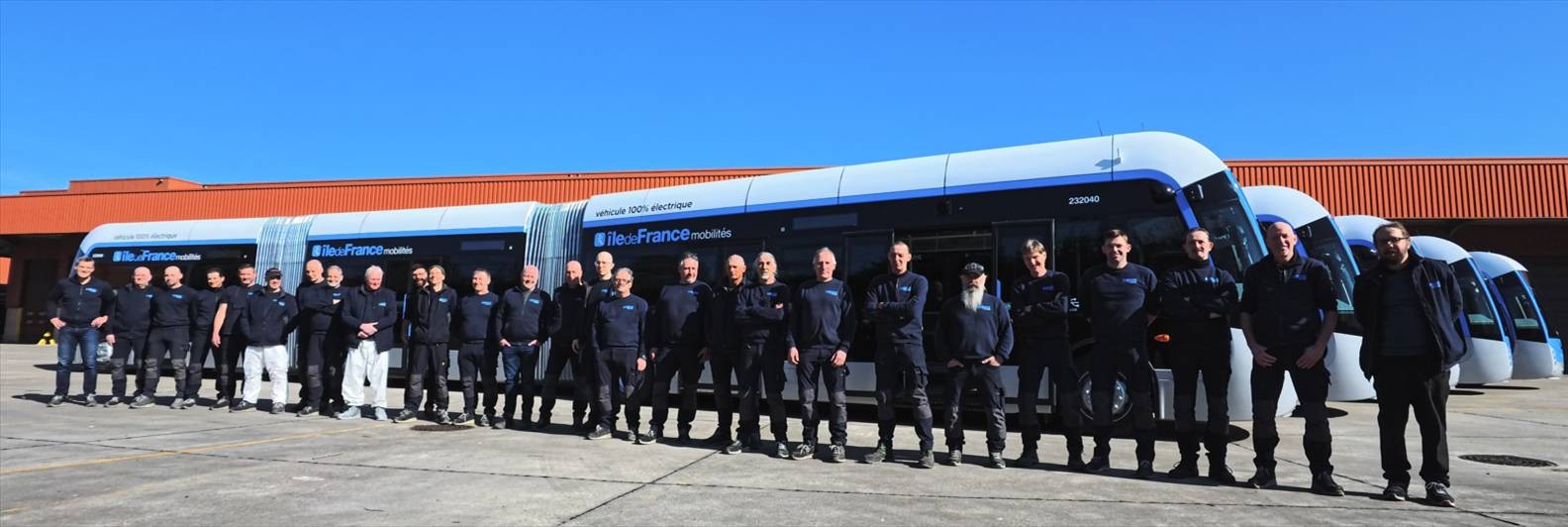
During the official opening, Van Hecke illustrated that point with a photograph of the team standing side by side over the full length of a bi-articulated bus.
“A 24-metre bus requires 24 metres of people,” he said.
The image says a lot about what is happening in Heist-op-den-Berg. The Exqui.City production line is not being restarted, but the knowledge accumulated around the vehicle has stayed together.
And that knowledge now has a new purpose.
The Exqui.City stops production, but not its journey
Following the bankruptcy of Van Hool, the intellectual property rights related to the Exqui.City first passed to VDL Van Hool. HESS subsequently acquired these rights through a technology transfer.
Its objective is clear: support operators in keeping their Exqui.City vehicles operational until the planned end of their service life.
That includes technical support, spare parts, software updates and possible vehicle modifications.
The relationship between the Van Hool legacy and HESS had already become visible in Paris.
Île-de-France Mobilités had ordered 30 battery-electric, 24-metre Exqui.City vehicles from Van Hool. Five had been delivered when Van Hool went bankrupt. HESS subsequently became involved in completing the remaining 25 vehicles, drawing on existing technology partners and former Van Hool expertise.
What initially looked like the completion of an unfinished project has therefore become something broader: ensuring continuity for an installed fleet.
HESS is putting more pieces together
The development also fits into a wider story at HESS.
Under CEO and owner Alex Naef, the Swiss company has been expanding the expertise it brings together around electric, high-capacity public transport.
In January 2026, HESS took over KIEPE's technological activities in the trolleybus segment. The move added KIEPE system know-how to HESS's existing vehicle and electric mobility expertise. It also built on a relationship between the two companies that goes back decades.
Now the Exqui.City technology and its associated know-how add another piece.
Vehicle engineering. Electric traction. Parts. Software. Service. Retrofit. Lifecycle support.
Rather than looking at each element separately, an ecosystem is gradually taking shape around keeping high-capacity electric public transport operational throughout its lifetime.
A service centre that goes beyond HESS and Van Hool
That broader thinking is also visible in Heist-op-den-Berg.
HESS Belgium does not want to be a workshop exclusively for HESS or former Van Hool vehicles. It positions itself as a European expertise and service centre, supporting operators with maintenance, repairs, diagnostics, parts and modernisation across different bus brands.
Retrofit is an important part of that ambition.
And the meaning of retrofit is changing.
For years, the word was often associated with replacing a diesel powertrain with an electric one. But as Europe's first generations of battery-electric buses grow older, another market is emerging.
A vehicle may need new batteries. Components may become obsolete. Software needs updating. Structural repairs may extend its useful life. New technology may improve energy efficiency or reliability.
In other words, retrofit is increasingly about much more than changing the propulsion system. It is about keeping a vehicle technologically and economically relevant for longer.
When knowledge gets a second life
Perhaps that is what makes the HESS Belgium story particularly interesting.
The bus industry is not made up only of factories, brands and products. A large part of its value sits in people: engineers, technicians and specialists who have accumulated knowledge over many years.
Van Hool disappeared as an independent manufacturer. The Exqui.City will no longer be produced as a new vehicle.
But the buses already on the road still have years of work ahead of them.
And so do the people who know how to keep them there.
In Heist-op-den-Berg, part of that knowledge has found a new home.
Author: Inge Buytaert Connect on the Busworld platform